
FLUX-ID™ — How We Make Creative Work Repeatable
The operating system behind every Neon Alchemy engagement, in full.
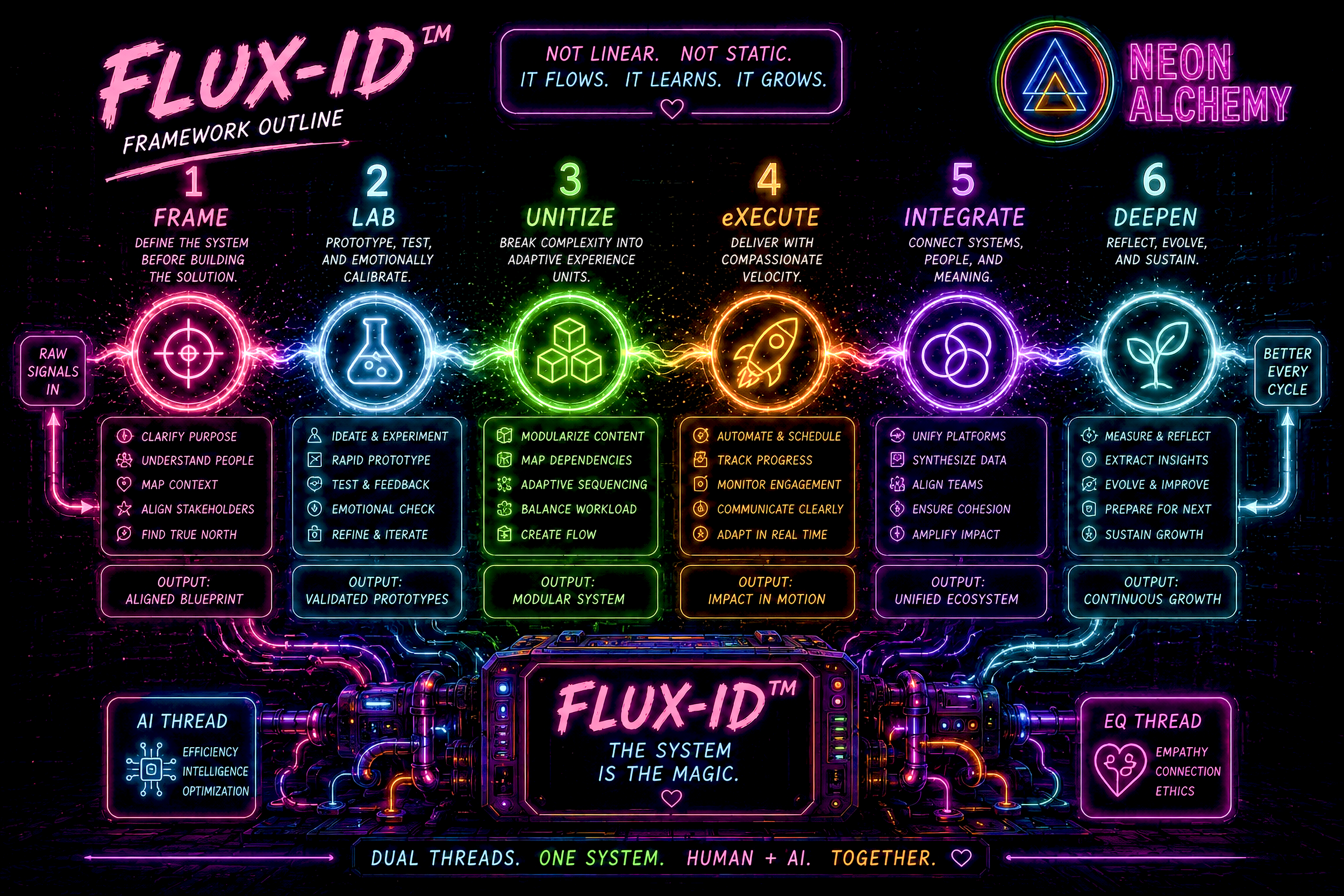
FLUX-ID is Neon Alchemy's six-phase operating system for creative work — Frame, Lab, Unitize, Execute, Integrate, Deepen. It's the reason our output is repeatable instead of lucky, and why every project compounds into the next.
Most creative work is unrepeatable. A campaign lands, and nobody can quite say why — so the next one is a fresh roll of the dice. FLUX-ID exists to fix that. It's the operating system we run every engagement through: six phases that turn creative work from a series of one-offs into a system that gets sharper each time.
Here's the whole thing, phase by phase.
Frame — 1
The real problem. Not the one in the brief. The one hiding underneath it.
Every brief is a description of a symptom. Before we make anything, we find the actual problem underneath it — the thing that, once solved, makes the surface request either easy or unnecessary. Getting this wrong is how good execution ends up pointed at the wrong target. Framing is where we make sure the work is aimed correctly before a single hour goes into producing it.
Lab — 2
Where the ideas get tested before they get expensive. Prototype fast. Calibrate before you commit.
Ideas are cheap in the Lab and expensive everywhere else. We prototype directions quickly and deliberately — enough to see what's working before the real production budget, timeline, and attention are committed. It's how we avoid the most common failure in creative work: discovering a direction was wrong only after it was fully built.
Unitize — 3
Break the complexity down. Human-scaled pieces. Nothing collapses under its own weight.
Big creative ambitions fail when they stay big. We break the work into human-scaled pieces — units small enough to actually finish, own, and ship — so nothing collapses under its own weight halfway through. This is what keeps momentum from stalling when a project gets ambitious.
Execute — 4
Moves fast. Holds under pressure. And things always get complicated.
Execution is where most of the work becomes visible, and where reality intrudes — scope shifts, deadlines compress, things get complicated. This phase is built to move fast and hold up anyway: production that ships on schedule and stays robust when the plan meets the world.
Integrate — 5
Every system connected deliberately. Teams, platforms, meaning — nothing lost in the handoff.
Creative work rarely lives alone. It has to connect — to your other channels, your team, your platforms, and the larger meaning of your brand. We integrate deliberately so nothing gets lost in the handoff between pieces, people, or systems. This is the phase that keeps a fast-growing company's creative output feeling like one thing instead of ten disconnected efforts.
Deepen — 6
Every project feeds the next. The work compounds. You stop starting from scratch.
This is the phase that makes the whole system worth it. Every engagement leaves behind assets, patterns, and understanding that the next one builds on — so instead of restarting each time, the work compounds. It's the difference between hiring output and building a creative capability that's worth more every month you keep it.
Why it's a loop, not a line
FLUX-ID reads as six steps, but Deepen feeds back into Frame — each cycle starts from a sharper understanding of your brand than the last. That's the mechanism behind a claim we make elsewhere on the site: every campaign builds on the last. It isn't a slogan; it's what the sixth phase is for.
It's also why a retained relationship beats project work for ongoing needs. A one-off engagement stops at Execute and walks away. A retainer runs the full loop, again and again, and the compounding is the payoff.
Want to see how FLUX-ID would apply to your work?